
By Vee Bird
Many people agree that dyslexia can be best identified in children after the age of 8 years, when Phonics education is suggested to be ceased. However, screening can be carried out to assist the identification of key dyslexia markers. So, the question is – When is the appropriate time for a child to be screened for dyslexia?
This question has been on my mind since one of my learners exclaimed ‘Finally!’ after his dyslexia was confirmed at the age of 13. Having found schoolwork to be difficult for ‘many years’, he understandably thought this support was late!
Sandra Pyne (co-creator of Jigsaw Phonics) is one of many who advocate early screening. As a mother of three (now adult-aged) children, she first noticed her son’s dyslexia when he was very young. This, she explains, was evident in a number of ways beyond her son’s difficulty with learning to decode (i.e. read by recognising the links between letters and sounds).
These key indicators included: Sandra’s son’s delayed speech in two languages (he’s bilingual in English and German); his word-finding issues (he would say ‘pizza’ when he meant ‘spaghetti’); his difficulties with sequencing (following multi-step instructions and remembering locker codes); and his preference for audiobooks as opposed to written texts. Sandra’s son’s irregular spelling (in which he spelled words in three different ways) was also a key marker. Plus, the fact that dyslexia was known to run in the family.
Caroline Rennison and her son, Joe (founders of Got-it-Learning) also support the early identification of dyslexia markers as being essential for children to reach their full potential. Caroline emphasises that this enables, ‘…teaching in a supportive and fun environment that is tailored to the child’s needs to ensure all learning is secure.’ Both Caroline and Joe stress how important this early identification is to build a young learner’s confidence: Joe has experienced this first-hand when he needed additional support at school for his dyslexia.
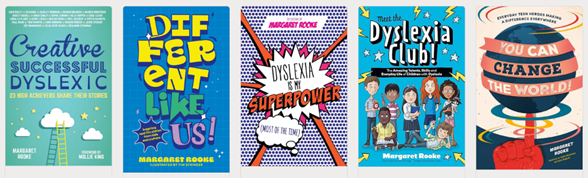
Margaret Rooke (author of Meet the Dyslexia Club) adds that children and teens that she has spoken to have told her how much they have benefited from the early identification of their dyslexia. This was discussed as being conducive to understanding their own strengths and challenges and ultimately enabled support that assisted them on their journey to work or university. There was a consensus that knowing that there was a reason why they found certain parts of schoolwork to be difficult, compared to their classmates, made them feel better about themselves.
So, in summary, the early identification of dyslexia is essential for a number of reasons. There are two stated quite simply here.
One: because knowing why a child/young person has certain difficulties serves to enhance their self-esteem and self-knowledge.
Two: it enables their school to enact the right support for a more equal education on their way to success.
Sandra’s son is now an artisan baker and innovative investor, whilst Joe is a co-founder of a rapidly-expanding dyslexia teaching resource business. They credit this success in part to dyslexic thinking skills (as discussed in my previous blog) and the support that early identification enabled.
As a further note to the early identification of dyslexia, it is important to acknowledge that the British Dyslexia Association (BDA, 2025) list possible indicators on their website. These include a child’s difficulties with learning nursery rhymes, the alphabet and sequencing, and an enjoyment of listening to stories, but a lack of interest in letters and words. Delayed speech development and the muddling of letters in words may also be evident, with dyslexia in the family being a key additional marker.
For more information, please see:
https://www.bdadyslexia.org.uk/advice/children/is-my-child-dyslexic/signs-of-dyslexia-early-years
You can also contact me at vee@lovelearningliteracy.com for further information and/or to book an assessment.
With thanks to Sandra Pyne https://www.jigsawphonicsmembership.com/

Caroline and Joe Rennison https://gotitlearning.co.uk/

& Margaret Rooke https://margaretrooke.com/
https://www.amazon.co.uk/Meet-Dyslexia-Club-Strengths-Neurodiverse/dp/1839978430
(*Waiver: I am not affiliated with the companies mentioned so they were asked to contribute for their sheer brilliance rather than my own financial gain)